Locations:





 Search
Burnout is often driven by long periods of stress without time to recover — but practicing self-care and creating work/life boundaries can help
If you’re feeling exhausted and sluggish, and even simple tasks feel overwhelming, you may be experiencing burnout.
Advertisement
Cleveland Clinic is a non-profit academic medical center. Advertising on our site helps support our mission. We do not endorse non-Cleveland Clinic products or services. Policy
Though burnout is often associated with job stress, it can also stem from — and affect — many areas of your life, as well as take a toll on your health.
Psychologist Adam Borland, PsyD, says there are ways to recognize burnout and take steps toward recovery.
Burnout is “physical, emotional or mental exhaustion, accompanied by decreased motivation, lowered performance and negative attitudes toward oneself and others,” as described by the American Psychological Association’s Dictionary of Psychology.
It’s not a medical condition, and it can be tough to describe. In fact, you may not realize you’ve hit burnout until you’ve crossed the line between “really tired” and “too exhausted to function.” And if you’re the kind of person who likes to stay busy, you may not even notice when you’re doing too much.
“If you’re used to going 100 miles an hour and then suddenly take your foot off the gas, you’re still going 85,” Dr. Borland illustrates. “But you may feel like that’s not good enough — precisely because you’re so used to going 100.”
Burnout and depression aren’t the same thing. But they can resemble one another (and can even show up together).
Usually, burnout is tied to a specific situation or environment, like work, while depression doesn’t always have a clear trigger. And stepping away from the source of your burnout can often bring relief. With depression, that’s less likely.
Advertisement
To understand the difference, imagine that you’re about to go on a nice vacation.
“Once you’re away from the source of your burnout, you’re able to relax and enjoy your vacation,” Dr. Borland explains. “But if you’re experiencing depression, you most likely won’t be able to do that. Your depressive symptoms accompany you on your trip.”
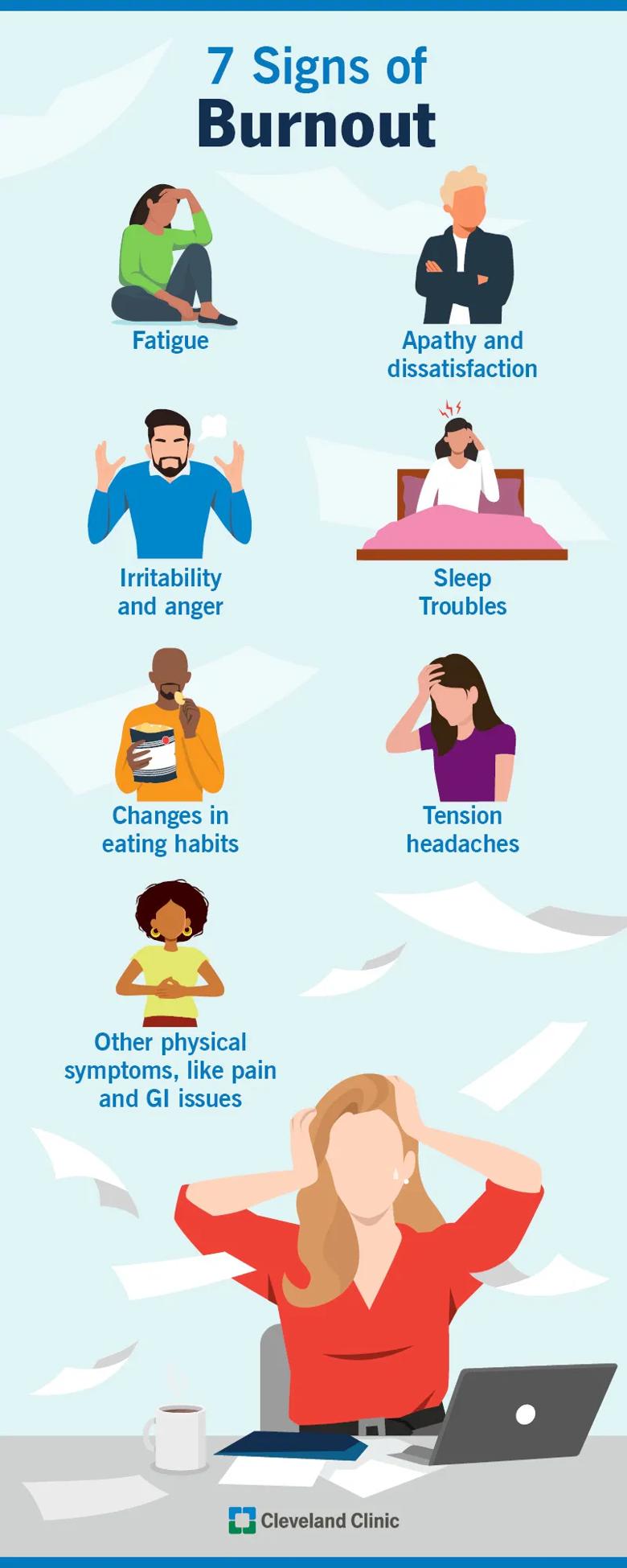
Image content: This image is available to view online.
View image online (https://assets.clevelandclinic.org/transform/7a1438d0-5e6d-4648-b094-21e450d2454c/burnout-infographic)
Burnout looks different for everyone, but it can lead to serious physical, mental and emotional effects. Common signs include:
Burnout is often driven by long periods of stress without giving yourself enough time to recover.
Some factors can increase your risk of burnout, like:
“Many of us have a difficult time maintaining necessary boundaries, especially given the technology that plays a significant part in our work today,” Dr. Borland notes. “We’re often expected to be accessible 24 hours a day.”
Various professional models of burnout name as few as three stages to as many as a dozen. But they all have one thing in common: “They show that burnout doesn’t happen all at once,” Dr. Borland states. “It develops gradually.”
Psychologists Herbert Freudenberger and Gail North are credited with developing one of the most popular models, the 12 stages of burnout. But today’s mental health providers often break it down into five simpler stages:
Advertisement
“You might not even recognize burnout in its early stages,” says Dr. Borland. “It’s usually only once burnout has really taken hold that people say, ‘Wait, something is really off here.’ That’s because we’re so used to going at that 100-mile-an-hour clip.”
Burnout can affect many areas of your life and even cause health problems. But thankfully, there are ways to cope with and even overcome this often-debilitating state.
These tangible steps can help you get back on a better path.
Advertisement
Remember: Focusing on yourself isn’t selfish. It’s an important means of staying well so you can do all the things you need to do — including being there for others.
“I often remind my patients that to be the best friend, spouse, parent or child, they have to attend to their self-care,” Dr. Borland reinforces. If your tank is empty, you can’t be the type of person you want to be for the others in your life.
Burnout is common, especially during prolonged periods of stress. But it’s also reversible.
“It takes work,” Dr. Borland acknowledges. “But it comes down to establishing a meaningful daily routine and creating and maintaining boundaries so you can tend to your health and well-being, while also attending to your other responsibilities.”
Recognizing the signs of burnout early and making small, intentional changes can help you restore balance and protect your physical and emotional well-being.
Advertisement

Sign up for our Health Essentials emails for expert guidance on nutrition, fitness, sleep, skin care and more.
Learn more about our editorial process.
Advertisement
Try breaking down tasks into manageable to-do lists and relying on time management techniques
If you’re torn between contradictory beliefs, questioning your decisions or feeling ashamed about your choices, you may be experiencing cognitive dissonance

This theory of human motivation says people seek to meet their needs in a predictable order

This trendy practice may boost your physical and mental health — but done incorrectly, it could make things worse
Only some people experience autonomous sensory meridian responses, but it can be beneficial to those who do

You can address negative thinking by reframing the situation, asking for help when you’re stuck and giving yourself some grace
The power of positive thinking can influence your physical, mental and emotional health
Speaking, thinking or writing these affirming statements can help boost confidence, reduce anxiety and overcome self-doubt

This ‘harm reduction’ approach to sobriety involves subbing one substance for another — a method that isn’t backed by research

Educate your child about body image, expectations and skin care first

A true chlorine allergy is extremely rare — it’s far more likely that you have a damaged skin barrier











